
The greater the post-listing gains, the higher the number of investors looking to sell.

Rs 135.3 crore. How much of it was salary, and how much commission?

Adani group is on track to surpass a combined Ebitda (earnings before interest, taxes, depreciation, and amortisation) of Rs 1 trillion in the ongoing financial year (FY25) as it prepares for a $2 billion (over Rs 16,700 crore) share sale by its flagship entity Adani Enterprises next month, according to a source close to the matter.

Reliance Group chairman Anil Ambani is reviewing "appropriate" options after the Securities and Exchange Board of India (Sebi) banned him from the stock markets and imposed a Rs 25-crore fine for alleged fund diversion from Reliance Home Finance (RHFL), a former subsidiary of Reliance Capital. In a statement, a spokesperson for Ambani said he had resigned from the boards of Reliance Infrastructure and Reliance Power pursuant to the Sebi interim order dated February 11, 2022.

The Indian equity markets will soon account for over a fifth of a key emerging market (EM) benchmark tracked by funds with assets exceeding $500 billion. This development is expected to funnel as much as $3 billion into the domestic markets. Following the latest review undertaken by global index provider MSCI, India's weighting in the MSCI EM index will surpass 20 per cent for the first time, narrowing its gap with the current top-weighted China to fewer than 400 basis points.

While praising the internship scheme announced in the Budget, India Inc wants clarity on how it will be implemented. The scheme is expected to help companies address the skill gap in employment. Dheeraj Hinduja, chairman, auto major Ashok Leyland, said: "We had started an internship programme at our plant in Pantnagar, which we established in 2010 with colleges there.

Chief executive officers (CEOs) across sectors have expressed intentions to expand capacities, expecting the government's target to invest a record Rs 11.11 trillion on infrastructure development will act as a catalyst for a jump in consumer demand. "With the government planning a capex of Rs 11.11 trillion, private sector investment will come in a big way. Companies will be preparing for it right from today," H M Bangur, chairman of Shree Cement, told Business Standard. For the past few years, the investment scene in India has been dominated by government capital expenditures; private investments in the manufacturing sector have remained muted.

Mauritius-based Hinduja group firm IndusInd International Holdings (IIHL) has informed the administrator of Reliance Capital that it is ready with its equity contribution of Rs 2,750 crore in cash to acquire the bankrupt firm, but it wants certain conditions to be met in accordance with the resolution plan before transferring the amount. IIHL has also filed an application with the Mumbai Bench of the National Company Law Tribunal (NCLT), seeking directions for the administrator and the committee of creditors (CoC) to complete all pending activities to close the transaction and not let the lenders invoke the bank guarantees provided by the firm earlier.

The Softbank-backed company has set a price band of Rs 72 to Rs 76 per share for the maiden share sale and is expected to test the appetite for new-age loss-making companies.

Anil Agarwal, chairman of metals major Vedanta group, has called for the sale of government stake in Bharat Gold Mine and Hutti Gold Mine so as to increase production of the yellow metal in the country. In a social media post, Agarwal said global gold prices are currently at record highs and India imports 99.9 per cent of its requirement. "With massive investments, we can be a major producer of gold and a big generator of employment," Agarwal said.

Over 70 per cent of individual investors who engage in intraday trading incurred an average loss of Rs 5,371 during 2022-23 (FY23), according to a study conducted by the Securities and Exchange Board of India (Sebi). Intraday trades involve buying and selling securities within the same trading day. The study covered nearly 7 million investors trading in the equity cash segment.

About two-thirds of the incremental net income of the Nifty 50 over FY19-24 has come from companies in relatively low-valued sectors such as banks, diversified financials, IT services, and metals and mining.

The fee pocketed by investment banks for handling equity share sales stood at $244 million during the first half of calendar year 2024. This was the highest first half figure since 2007, according to LSEG Data & Analytics, a provider of financial markets data. Capital mobilised via equity capital market (ECM) activity jumped 2.5 times to $29.5 billion - the highest-ever semi-annual total in terms of proceeds.

Singapore government's sovereign wealth fund Temasek is looking to invest $10 billion in India during the next three years, Ravi Lambah, Temasek's head of India and strategic initiatives, said.

Bain Capital-backed Tyger Capital is planning to list its shares on the Indian stock exchanges by the next financial year and is targeting to grow its assets under management by four times to Rs 20,000 crore in five years from Rs 5,000 crore now, Gaurav Gupta, MD and CEO of the firm said. In an exclusive interview, Gupta said that keeping with the growing business, the finance company expects to on-board 600 people in the current financial year as it is opening 60-65 new branches for broad-basing its network in the country.

Equity supply may hit Rs 6 trillion soon.

Life Insurance Corporation of India (LIC) has made the most of the stock market boom by reducing stakes in all its top conglomerates during the financial year 2023-2024 (FY24). However, even after reducing exposure, the value of its remaining stake has gone up substantially across all groups, according to data collated from stock exchange filings.

The Nifty 50 index is poised for a revamp as the revised futures and options (F&O) stock selection criteria is seen paving the way for newly listed companies to join the benchmark index, which is tracked by passive funds with combined assets under management of more than ~3.5 trillion ($44 billion). For the first time in six years, the market regulator Securities and Exchange Board of India (Sebi) has tweaked the stock selection process for the derivatives segment that clocks a turnover of ~400 trillion daily.
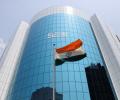
If Hindenburg or its partner do not join the investigation, then Sebi may pass an ex-parte order against it, which may be enforced as a foreign award in US courts.

 © 2026 Rediff.com - Advertise with us - Disclaimer - Privacy Policy - Sitemap - Feedback - About us - Terms of use - Grievances